A Parent’s Guide to Speech Clarity, Developmental Milestones, and When to Seek Support
Discover the top signs your toddler needs speech therapy in Fort Worth (Saginaw area). Learn when to seek help from Little Red Wagon Pediatric Therapy.
“Why can I understand my child, but other people can’t?”
If you’ve ever found yourself translating what your toddler or preschooler is saying to grandparents, teachers, or friends, you’re definitely not alone!
As children grow, their speech becomes clearer, and they’re able to produce more sounds and words. But knowing what’s typical at different ages can leave parents with lots of questions.Should a 2-year-old be easy to understand? What about a 3-year-old? And when should children be able to pronounce all their sounds correctly
At Little Red Wagon Therapy, we love helping families better understand their child’s speech development.
Our pediatric speech therapists support children in Saginaw, TX, northwest Fort Worth, Lake Worth, and surrounding communities, using individualized, play-based therapy to help children improve speech clarity and build communication confidence.
Let’s explore how speech develops, what milestones parents can look for, and when an evaluation may be helpful.
1. What Does Speech Clarity Mean?
Speech clarity refers to how easily other people can understand what a child is saying.
Speech-language pathologists often use the term speech intelligibility to describe how understandable someone’s speech is.
For young children, speech clarity develops gradually as they learn how to coordinate their lips, tongue, jaw, and other structures to produce different speech sounds.
You might notice your child:
- Says some words clearly but has difficulty with others.
- Substitutes one sound for another, such as saying “wabbit” instead of “rabbit.”
- Leaves sounds out of longer words.
- Has speech that’s easier for familiar adults to understand than unfamiliar listeners.
Many of these patterns can occur during typical speech development.
The important question isn’t whether your child says every sound perfectly. It’s whether their overall speech clarity is developing as expected for their age.
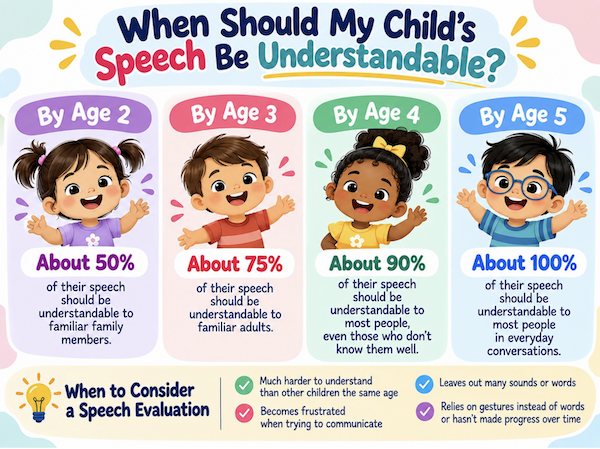
2. When Should My Child’s Speech Be Understandable by Age?
Every child develops at their own pace, but research provides helpful guidelines for understanding how speech clarity typically changes over time.
Here are general milestones to keep in mind.
By Age 2: Speech Is Developing Rapidly
Around age 2, children are learning new words, combining words, and developing their speech sound skills.
Their speech may still be difficult for unfamiliar listeners to understand.
In research examining unfamiliar listeners’ understanding of children’s speech, the median child was approximately 50% understandable in connected speech by around 34 months.
What parents may notice:
- Familiar words are becoming easier to recognize.
- Some sounds are still substituted or omitted.
- Parents often understand more than unfamiliar adults.
- Speech clarity continues improving with development.
At this age, it’s important to consider overall communication development, not just pronunciation.
By Age 3: Speech Is Becoming Clearer
Around age 3, many children are using longer phrases and sentences, giving them more opportunities to practice speech sounds.
Their speech should generally be becoming easier to understand.
Research suggests that the median child reaches approximately 75% intelligibility in connected speech around 46 months, although children vary considerably.
What parents may notice:
- More words and phrases are understandable.
- Familiar adults can often understand much of what the child says.
- Some speech sound errors are still present.
- Unfamiliar listeners may still have difficulty understanding certain words.
If your child’s speech is frequently difficult to understand or progress seems limited, a speech-language evaluation can provide helpful information.
By Age 4: Most Speech Should Be Understandable
By age 4, children’s speech is generally becoming much clearer, including when speaking with people who don’t know them well.
The American Speech-Language-Hearing Association (ASHA) notes that by age 4, most people should understand what a child says, although some sounds may still be developing.
What parents may notice:
- Conversations are easier for unfamiliar listeners to follow.
- Most everyday words and sentences are understandable.
- Some later-developing sounds may still be difficult.
- Speech clarity continues improving with age.
A child doesn’t need to pronounce every sound perfectly to be understandable.
However, if unfamiliar listeners frequently struggle to understand your 4-year-old, an evaluation may be beneficial.
By Age 5: Speech Is Generally Easy to Understand
By age 5, children are typically understandable in everyday conversations, even though some speech sounds may still be developing.
Research suggests that children generally reach high levels of speech intelligibility by the early school years.
What parents may notice:
- Most conversations are easy to understand.
- Children can communicate increasingly complex ideas.
- Some later-developing sounds may still need practice.
- Speech sound production continues to mature.
If your child’s speech is frequently unclear or certain sound patterns persist, a pediatric speech-language pathologist can help determine whether additional support is needed.
Important reminder: These are general developmental guidelines, not strict deadlines. A child’s speech clarity should be considered alongside their overall communication development, language background, and individual abilities.
3. Why Can Parents Understand Their Child Better Than Other People?
Here’s something we hear from parents all the time:
“I understand almost everything my child says, but nobody else does!”
There’s actually a good reason for that!
Parents and caregivers spend a lot of time listening to their children. Over time, they become familiar with their child’s speech patterns, favorite words, routines, and the context of conversations.
For example, your child might say “tar” when asking for their favorite toy car.
You know exactly what they mean because you’ve heard that word many times!
But someone unfamiliar with your child’s speech might not immediately understand.
That’s why speech-language pathologists often consider how well both familiar and unfamiliar listeners understand a child.
If you’re frequently translating your child’s speech for others, it may be worth discussing with a pediatric speech therapist.
4. What Are Speech Sound Disorders?
A speech sound disorder occurs when a child has difficulty producing or organizing speech sounds in ways that affect their speech clarity.
Speech sound difficulties can involve several patterns.
Sound substitutions: Saying one sound instead of another, such as “tat” for “cat.”
Sound omissions: Leaving out sounds, such as saying “poon” instead of “spoon.”
Sound distortions: Producing a sound in an unusual way, such as certain types of lisps.
Some speech sound errors are developmentally appropriate at younger ages.
However, when errors persist beyond expected ages, occur frequently, or significantly affect how well others understand a child, speech therapy may be beneficial.
An evaluation can help determine whether your child’s speech sound patterns are age-appropriate or whether additional support would be helpful.
5. How Can Pediatric Speech Therapy Improve Speech Clarity?
At Little Red Wagon Therapy, we believe speech therapy should be engaging, motivating, and individualized to each child’s needs.
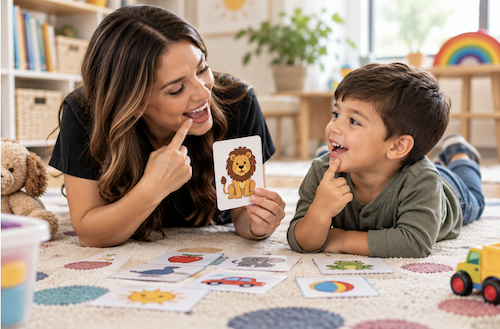
That’s why our pediatric speech therapists incorporate play-based articulation therapy into treatment.
While children are enjoying games, toys, and interactive activities, they’re also working toward meaningful speech goals!
For example:
Board Games: Children can practice target speech sounds during turns, requests, and game-related conversations.
Pretend Play: Toy animals, dolls, and play kitchens create opportunities to practice words and sounds in meaningful situations.
Puzzles: Therapists can incorporate sound practice while children request pieces, name objects, and describe pictures.
Books: Stories and picture books offer opportunities to practice speech sounds in words, phrases, and sentences.
Our speech-language pathologists select activities based on each child’s specific goals and developmental needs.
The goal isn’t just to practice a sound during therapy. It’s to help children use clearer speech in everyday communication!
6. How Can Parents Encourage Clear Speech at Home?
Parents play an important role in supporting communication development.
Here are a few simple strategies that can make everyday interactions meaningful.
Model Words Clearly
If your child says “tat” for “cat,” you can naturally respond:
“Yes! That’s a CAT! A fluffy cat!”
This gives your child a clear speech model without turning every conversation into a correction.
Read Books Together
Books provide opportunities to hear words repeatedly, practice sounds, and talk about familiar pictures.
Choose books your child enjoys and keep the experience interactive.
Play With Sounds
Animal noises, silly sound effects, and playful words can make speech sound exploration fun.
For example, pretend a snake says “ssss” or a train says “choo-choo!”
Focus on Communication, Not Perfection
It’s important for children to feel comfortable sharing their thoughts and ideas.
Rather than correcting every sound error, focus on responding to what your child is communicating.
If your child is already receiving speech therapy, their speech-language pathologist can recommend specific activities that support their individualized goals.
7. When Should You Consider a Speech Evaluation?
Every child develops differently, but there are situations when a speech-language evaluation may be helpful.
Consider contacting a pediatric speech therapist if:
- Your child’s speech is frequently difficult for others to understand.
- You’re regularly translating what your child says.
- Your child has difficulty producing speech sounds expected for their age.
- Speech clarity doesn’t seem to be improving over time.
- Your child becomes frustrated when others don’t understand them.
- Teachers or caregivers have expressed concerns about speech clarity.
- You have questions about your child’s communication development.
You don’t have to wait for a specific birthday or milestone to ask questions.
A pediatric speech-language pathologist can evaluate your child’s speech sound development, identify strengths and areas of need, and recommend whether therapy would be beneficial.
A hearing evaluation may also be recommended when hearing concerns could be affecting speech development.
8. Pediatric Speech Therapy in Saginaw, TX, and Surrounding Areas
At Little Red Wagon Therapy, we’re passionate about helping children develop clearer speech and greater confidence in their communication abilities.
Our pediatric speech therapy services support children with:
- Articulation difficulties
- Speech sound disorders
- Reduced speech intelligibility
- Speech and language delays
- Other communication challenges
Through individualized, play-based treatment, our speech-language pathologists help children practice important skills in ways that keep them engaged and motivated.
Contact Little Red Wagon Therapy today to learn more about our pediatric speech therapy services or schedule a speech and language evaluation!