
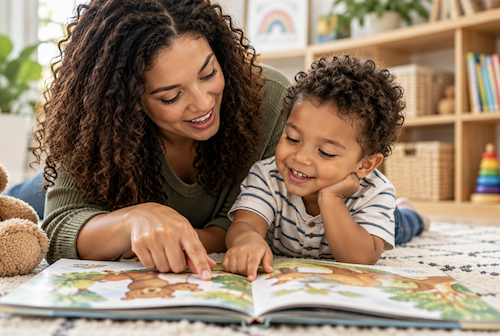
Simple Ways to Support Your Child’s Language Development Through Everyday Reading
Simple Ways to Support Your Child’s Language Development Through Everyday Reading
Did you know that one of the most powerful tools for supporting your child’s speech and language development might already be sitting on your bookshelf?
Reading with your child is about so much more than learning letters or preparing for school. It’s an opportunity to build vocabulary, encourage communication, strengthen understanding, and create meaningful connections.
And here’s the best part: You don’t have to read every word on the page to make a difference!
At our pediatric speech therapy clinic serving Saginaw, TX, and surrounding communities, we believe that some of the most meaningful learning happens through everyday interactions. Reading together is a wonderful example of how simple, playful moments can support important communication skills.
Let’s explore why reading is so beneficial and how you can make storytime a language-building experience!
1. Reading Together Helps Build Vocabulary
Children learn language by hearing words used in meaningful situations. Books introduce vocabulary that might not come up during everyday conversations.
Think about it: A trip to the grocery store might introduce words like cart, apples, and shopping. But a book about animals could introduce words like enormous, furry, stomp, and explore.
The more opportunities children have to hear words in context, the more chances they have to understand and eventually use them.
Try this at home:
- Point to pictures and name what you see.
- Describe objects using colors, sizes, and actions.
- Repeat important words naturally throughout the story.
- Expand on what your child says.
For example, if your child points to a dog and says, “Dog!” you might respond, “Yes! A big brown dog! He’s running!”
This simple technique, called language expansion, helps children hear how their own words can grow into longer, more detailed phrases.
2. Storytime Encourages Communication and Conversation
Reading doesn’t have to be a one-person activity where the adult talks and the child listens.
In fact, some of the best language-building opportunities happen when children become active participants!
When you pause, comment on pictures, or invite your child to share an idea, you’re creating opportunities for back-and-forth communication.
These interactions can help children practice:
- Taking turns in conversation
- Answering and asking questions
- Expressing wants, thoughts, and ideas
- Using new vocabulary
- Building longer sentences
Try this at home:
Instead of asking question after question, mix in fun comments!
You might say:
“Wow! That bear is HUGE!”
“Uh-oh! The puppy fell down!”
“I wonder where the bunny is going!”
Then pause and give your child an opportunity to respond.
Remember, communication isn’t always spoken. Pointing, gestures, facial expressions, and sounds are also meaningful ways children participate.
3. Books Strengthen Receptive and Expressive Language Skills
You may have heard a speech-language pathologist use the terms receptive language and expressive language.
But what do they actually mean?
Receptive language is how we understand words, sentences, directions, and information.
Expressive language is how we communicate our thoughts, wants, needs, and ideas using words, gestures, signs, or other communication methods.
Reading together can support both!
For receptive language, children practice listening, identifying pictures, understanding concepts, and following what happens in a story.
For expressive language, children have opportunities to label objects, describe pictures, answer questions, and share ideas.
Try this at home:
While reading, ask your child to:
- Find the red balloon.
- Point to the sleeping puppy.
- Tell you what the character is doing.
- Describe their favorite part of the story.
Choose activities that match your child’s current communication abilities, and keep the experience playful rather than turning storytime into a quiz.
4. Reading Supports Comprehension and Early Thinking Skills
Books introduce children to more than new words. They also help them understand how events connect.
Stories often have a beginning, middle, and end. Characters experience problems, make choices, and discover solutions.
Talking about these events can support important skills such as:
- Understanding cause and effect
- Recognizing emotions
- Making predictions
- Sequencing events
- Answering who, what, where, and why questions
For example, while reading a story about a child who loses a favorite toy, you might ask:
“How do you think she feels?”
“Where should she look next?”
“What do you think will happen?”
These conversations encourage children to think about what they’re hearing and connect language to ideas.
For younger children, simply pointing to a character’s happy or sad face can be a great starting point!
5. You Don’t Have to Read Every Word!
Here’s something we love reminding parents:
It’s perfectly okay to skip pages, shorten sentences, or simply talk about the pictures!
For young children, especially those still developing early communication skills, following their interests can be more engaging than reading a book from beginning to end.
If your child wants to spend five minutes looking at one picture of a dinosaur, that’s okay!
Talk about the dinosaur. Make roaring sounds. Describe its big feet. Pretend it’s walking across the room.
You’re still building language skills!
The goal isn’t to finish the book. The goal is to create meaningful opportunities for interaction, connection, and communication.
6. Five Easy Ways to Make Reading More Interactive
Ready to turn your next storytime into a language-building activity?

Here are five simple strategies our pediatric speech therapists encourage families to try.
1. Let your child choose the book.
Children are often more engaged when they’re interested in the topic.
2. Follow your child’s lead.
If they’re interested in a particular picture, spend time talking about it.
3. Use silly voices and sound effects.
Animal noises, vehicle sounds, and exaggerated expressions can make storytime exciting and encourage participation.
4. Pause and wait.
Give your child time to point, gesture, make a sound, or share a thought before continuing.
5. Read favorite books again and again.
Repetition gives children additional opportunities to become familiar with vocabulary, anticipate phrases, and participate in the story.
And remember: A few enjoyable minutes of shared reading can be more meaningful than a longer session that feels stressful or forced.
7. When Might Your Child Benefit From Speech Therapy?
Every child develops communication skills at their own pace.
However, if you have questions about your child’s language development, a pediatric speech-language pathologist can help you better understand their strengths and areas where additional support may be beneficial.
Some reasons families seek a speech and language evaluation include:
- Difficulty understanding or following age-appropriate directions
- Using fewer words or shorter sentences than expected for their age
- Difficulty expressing wants, needs, or ideas
- Challenges answering questions or participating in conversations
- Speech that is frequently difficult for others to understand
- Concerns about communication milestones or loss of previously acquired skills
You don’t have to wait until your child is struggling significantly to ask questions.
A speech-language evaluation can help determine whether your child’s communication development is progressing as expected and whether speech therapy could be beneficial.
Pediatric Speech Therapy in Saginaw, TX, and Surrounding Areas
At our pediatric therapy clinic, we believe learning should be engaging, meaningful, and individualized to each child.
Our speech-language pathologists use play-based pediatric speech therapy to help children develop important communication skills while building confidence and enjoying the learning process.
Our pediatric speech therapy services can support children with:
- Expressive and receptive language development
- Speech sound production and articulation
- Vocabulary and sentence development
- Social communication skills
- Speech and language delays
- Other communication challenges
We proudly serve families in Saginaw, TX, northwest Fort Worth, Lake Worth, and surrounding communities.
Ready to Support Your Child’s Communication Development?
Whether you’re wondering about your child’s language milestones or looking for pediatric speech therapy near Saginaw, TX, our team is here to help.
Every child deserves the opportunity to communicate, connect, and grow with confidence!
Contact our clinic today to learn more about our pediatric speech therapy services or schedule a speech and language evaluation.
Does reading to a toddler help with speech development?
Yes. Shared reading provides opportunities to hear new words, practice communication, and develop language comprehension. Talking about pictures, modeling words, and allowing children to participate can make reading especially interactive.
How long should I read to my toddler each day?
There’s no single perfect amount of time. Short, enjoyable reading sessions that match your child’s attention and interests can be beneficial. Consistency and meaningful interaction matter more than finishing a certain number of pages.
Can reading replace speech therapy?
Reading is a valuable way to support language development at home, but it doesn’t replace individualized speech therapy when a child needs professional support. A speech-language pathologist can help identify specific communication goals and recommend appropriate strategies.
