Understanding How Children Communicate and When Speech Therapy May Help
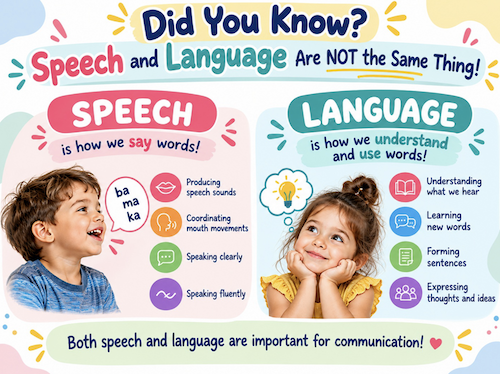
🗣️ Did you know that speech and language are NOT the same thing?
“Why can I understand my child, but other people can’t?”
IIt’s true! Although we often use the words speech and language interchangeably, they actually refer to different communication skills.
A child can have perfectly clear speech but experience difficulty understanding or using language. Another child might understand everything being said but have difficulty producing certain speech sounds.
And some children may need support in both areas!
At Little Red Wagon Therapy, we believe helping parents understand their child’s communication development is an important part of supporting their growth.
Our pediatric speech therapists work with children and families in Saginaw, TX, northwest Fort Worth, Lake Worth, and surrounding communities, providing individualized, play-based speech therapy to help little ones develop communication skills and confidence.
Let’s break down the differences between speech and language, what development can look like, and when a speech-language evaluation may be beneficial.
1. What Is Speech?
Speech refers to how we physically produce sounds and words when communicating.
It involves coordinating our lips, tongue, jaw, breath, and voice to produce spoken messages.
Speech includes three main areas:
Articulation: How we produce individual speech sounds, such as /s/, /r/, /k/, and /th/.
Fluency: The smoothness and rhythm of speech. Some children experience disruptions in fluency, such as stuttering.
Voice: How our voice sounds, including pitch, loudness, and vocal quality.
What Can Speech Difficulties Look Like in Children?
You might notice your child:
- Substitutes one sound for another, such as saying “tat” instead of “cat.”
- Leaves sounds out of words.
- Has difficulty producing certain speech sounds.
- Is frequently difficult for unfamiliar listeners to understand.
- Repeats sounds or syllables or experiences interruptions in speech flow.
- Has an unusually hoarse, breathy, or strained voice.
It’s important to remember that children develop speech sounds gradually. Some sound substitutions are expected at certain ages.
However, when speech difficulties persist beyond expected developmental milestones or affect a child’s ability to communicate, an evaluation by a speech-language pathologist may be helpful.
How can speech therapy help?
Pediatric speech therapy can target speech sound production, articulation, fluency, and other speech-related skills based on each child’s individual needs.
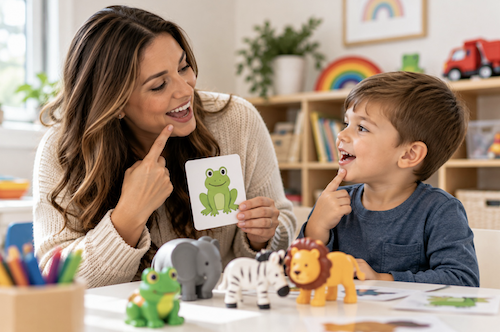
At Little Red Wagon Therapy, our therapists incorporate motivating, play-based activities that provide meaningful opportunities for children to practice their speech goals.
Because practicing speech sounds can happen during games, pretend play, and activities children genuinely enjoy!
2. What Is Language?
Language is how we understand, organize, and communicate meaning.
It includes the words we know, how we put words together, how we understand what others say, and how we share our thoughts and ideas.
Language can be spoken, written, signed, or communicated through other methods, including augmentative and alternative communication (AAC).
There are two important areas of language development that parents should understand.
Receptive Language: Understanding Communication
Receptive language refers to how we understand words, sentences, questions, and directions.
Children use receptive language skills throughout their day.
Examples include:
- Understanding familiar words and phrases
- Following age-appropriate directions
- Identifying objects and pictures
- Understanding questions
- Learning concepts such as colors, sizes, and locations
- Understanding stories and conversations
For example, when you say, “Go get your shoes and bring them to me,” your child uses receptive language skills to understand the request.
Expressive Language: Sharing Thoughts and Ideas
Expressive language refers to how we communicate our thoughts, wants, needs, and ideas.
This may include spoken words, gestures, signs, or AAC.
Examples include:
- Naming familiar objects
- Requesting favorite toys or activities
- Combining words into phrases and sentences
- Asking and answering questions
- Describing experiences
- Sharing thoughts, feelings, and ideas
For example, when your child says, “I want the big red ball!” they are using expressive language to communicate a specific request.
Here’s something important to remember: A child may have stronger receptive language skills than expressive language skills, or vice versa.
That’s why a comprehensive speech-language evaluation looks at multiple areas of communication rather than focusing only on how clearly a child speaks.
3. Can a Child Have Good Speech but Difficulty With Language?
Absolutely!
This is one of the biggest misconceptions about pediatric speech and language development.
A child may pronounce words clearly but still experience challenges with:
- Understanding directions
- Answering questions
- Forming age-appropriate sentences
- Explaining ideas
- Understanding stories
- Participating in conversations
For example, imagine a child who can clearly say the words “dog,” “running,” and “park” but has difficulty combining them into a sentence or explaining what happened at the park.
Their speech sounds may be clear, but their expressive language skills may need additional support.
Now consider another child who understands complex directions, knows what they want to say, and uses detailed sentences, but has difficulty producing certain sounds clearly.
That child may benefit from articulation therapy rather than language therapy.
Both children may benefit from pediatric speech therapy, but their treatment goals would look very different!
This is why individualized evaluation and treatment are so important.
4. Speech Delay vs. Language Delay: What’s the Difference?
Parents often hear the terms speech delay and language delay, but they don’t always mean the same thing.
A speech delay generally refers to speech skills developing later than expected. This may involve difficulties producing speech sounds or being understood.
A language delay refers to language understanding or expression developing later than expected.
For example:
Speech-related concern: A child knows what they want to say but has difficulty producing certain sounds clearly.
Language-related concern: A child has difficulty understanding age-appropriate directions or combining words into sentences.
Some children experience challenges in both speech and language development.
It’s also important to distinguish a developmental delay from a language difference. Children who are learning more than one language may develop skills differently across their languages, and multilingualism itself does not cause a language disorder.
A qualified speech-language pathologist can evaluate a child’s communication skills while considering their age, developmental history, and language background.
5. How Does Play-Based Speech Therapy Help?
At Little Red Wagon Therapy, we believe children learn best when they’re engaged, motivated, and actively participating!
That’s why play is such an important part of our pediatric therapy approach.
What might look like a simple game, puzzle, or pretend-play activity can actually involve meaningful opportunities to practice communication skills.
For example:
Playing Board Games: Children can practice target speech sounds, vocabulary, turn-taking, following directions, and sentence formation.
Pretend Play: Activities involving toy animals, dolls, or play kitchens can encourage children to describe actions, ask questions, and use new words.
Reading Books: Shared reading supports vocabulary, comprehension, expressive language, and conversational interaction.
Playing With Puzzles: Therapists can incorporate requesting, labeling, describing, following directions, and practicing specific speech sounds.
The activities may look different for each child because their therapy goals are individualized.
The goal is to make meaningful progress while keeping children engaged and motivated to communicate!
6. How Can Parents Support Speech and Language Development at Home?
The good news? You don’t need special equipment or complicated activities to encourage communication development.
Everyday routines provide wonderful opportunities to build speech and language skills!
Here are five simple strategies to try.
Talk About Everyday Activities
Describe what you’re doing during meals, bath time, getting dressed, or playing.
For example: “We’re washing your hands! Scrub, scrub, scrub!”
Hearing words during familiar activities helps children connect language to meaningful experiences.
Expand on What Your Child Says
If your child says, “Car!” you might respond, “Yes! A fast blue car!”
This models additional vocabulary and sentence structure without requiring your child to repeat everything.
Offer Choices
Instead of asking an open-ended question, try giving two options.
“Do you want the red cup or the blue cup?”
Choices provide opportunities to understand and communicate preferences through words, gestures, or other communication methods.
Read Together
Books are fantastic tools for building vocabulary, comprehension, and conversation.
Point to pictures, name objects, describe actions, and follow your child’s interests.
You don’t even have to read every word!
Pause and Give Your Child Time
After asking a question or making a comment, pause and allow your child time to respond.
Children may need additional processing time, and responses can take many forms, including pointing, gestures, sounds, or words.
Remember: The goal is meaningful communication, not perfection!
7. When Should You Consider a Speech and Language Evaluation?
Every child develops at their own pace, and communication milestones can vary.
However, there are situations when speaking with a pediatric speech-language pathologist may be beneficial.
Consider reaching out if your child:
- Is frequently difficult for others to understand
- Has difficulty producing age-expected speech sounds
- Uses fewer words or shorter sentences than expected for their age
- Has difficulty understanding age-appropriate directions
- Struggles to express wants, needs, or ideas
- Has difficulty answering questions or participating in conversations
- Becomes frustrated when trying to communicate
- Loses previously acquired speech or language skills
If you have concerns, you don’t have to wait to ask questions.
A speech-language evaluation can help identify your child’s communication strengths, determine whether additional support is needed, and guide individualized treatment recommendations.
8. Pediatric Speech Therapy in Saginaw, TX, and Surrounding Areas
At Little Red Wagon Therapy, we’re passionate about helping children develop the communication skills they need to connect with the world around them.
Our pediatric speech therapy services support a variety of communication needs, including:
- Articulation and speech sound disorders
- Expressive language difficulties
- Receptive language difficulties
- Speech and language delays
- Social communication skills
- Other pediatric communication challenges
Through individualized, play-based therapy, our speech-language pathologists create opportunities for children to learn, practice, and build confidence in their communication abilities.We proudly support families in Saginaw, TX, northwest Fort Worth, Lake Worth, and surrounding communities.